When Memory Flutters: Hormones and the Inner Life of Perimenopause

When Memory Flutters: Art, Hormones and the Inner Life of Perimenopause
There is a particular kind of forgetting that happens in perimenopause that no one really warns you about. Not the dramatic, frightening forgetting that people associate with dementia — something quieter than that, and stranger. You walk into a room and the reason dissolves before you reach the doorway. A word you have used a thousand times hovers just out of reach. A conversation from last Tuesday feels as though it happened in another life, or possibly to someone else entirely.
For many women, this is one of the most disorienting parts of the hormonal transition — not the hot flushes, which at least have a name and a narrative, but this soft, flickering quality that descends on memory and thought. The sense that your own mind has become unreliable. That you are somehow less yourself. I have yet to experience the hot flushes yet but have noticed issues with my memory for a while now….
I needed to know what is actually happening, of course, it is biology. And understanding it doesn't make it less strange, but it can make it feel less like a personal failing. For me it was the paranoia of worst case scenario. (In any case these things should be checked perimenopausal or not and should not be self diagnosed).
What Hormones Do to the Brain
Oestrogen is not just a reproductive hormone. It is deeply involved in brain function influencing mood, cognition, verbal memory, and the speed at which neurons communicate. During perimenopause, as oestrogen levels begin to fluctuate and eventually decline, the brain is responding to a significant shift in its chemical environment. Your brain is managing and adjusting to the changes. Just like when women have babies, you would have heard the term ‘baby brains’. The term always used in a negative context is actually our brains making space for baby related concerns and keeping a small human being alive.
Research has shown that oestrogen plays a role in supporting the hippocampus, the part of the brain most associated with forming and retrieving memories. When oestrogen drops, so can the efficiency of these processes. Women often report difficulty with word retrieval, short-term memory lapses, and a kind of mental fogginess that can feel alarming if you don't know what's causing it.
Progesterone, too, has a calming effect on the nervous system, and as its levels fall, many women find themselves more anxious, more reactive, sleeping less well — all of which compound the cognitive effects. Sleep deprivation alone is enough to impair memory consolidation, and when you layer hormonal disruption on top of broken nights, the effects on clarity of mind can be significant.
This is not a niche experience. Research suggests that up to two thirds of women report cognitive symptoms during perimenopause and menopause — yet it remains one of the least discussed aspects of the transition. I personally didn’t realise until recently that this could all be linked. As a woman in her forties and feeling many changes within my body mentally and physically the possible symptoms of perimenopause just seem never ending but the memory issues didn’t seem obvious until I was having more and more discussions around Perimenopause.
The Emotional Weight of a Shifting Mind
So what now? Now that I have come to this realisation?
What the science doesn't always capture is what it feels like to live inside this experience. The cognitive symptoms of perimenopause rarely arrive in isolation. They come alongside shifting identity, changing relationships, children growing up or careers evolving, ageing parents, a body that feels newly unfamiliar. Memory is not just a function, it is how we hold our sense of self. It is how we know who we are, where we have been, what we have built.
When memory becomes unreliable, it can touch something much deeper than inconvenience. Women describe a grief that is hard to name, not mourning a person, but mourning a version of themselves. The sharp, quick self who never lost her thread in a meeting. The one who remembered every birthday without prompting. The one who felt, in some fundamental way, in command of her own mind. I am constantly finding ways to adjust and cope with the changes. Quietly acknowledging this to yourself first can help. Once you have accepted the situation you can then make changes to help yourself.
This is the emotional terrain that so much of the conversation around menopause still doesn't reach, maybe if it did we would be able to regulate and even understand ourselves better. We have made progress in talking about the physical — HRT is more accessible, hot flushes are acknowledged, the workplace conversation has begun. But the inner life of this transition — the way it reshapes a woman's relationship with time, with memory, with herself — is still largely unwitnessed.
We are often demonised to be going through something we have for the most part no control over and yet no support. The lack of empathy is shocking.
Why Art Matters Here
There is something that art can do that information cannot. It can make a person feel seen.
When we encounter an image, a piece of music, a poem, that holds an experience we thought was ours alone, something shifts. The isolation lifts. The experience becomes, if not easier, at least less lonely. This is why art made from and for women's inner lives carries a particular kind of weight — especially when it reflects experiences that the wider culture has historically overlooked or dismissed. If we can create more art to represent womanhood and our difficulties the more awareness and conversations can be had.
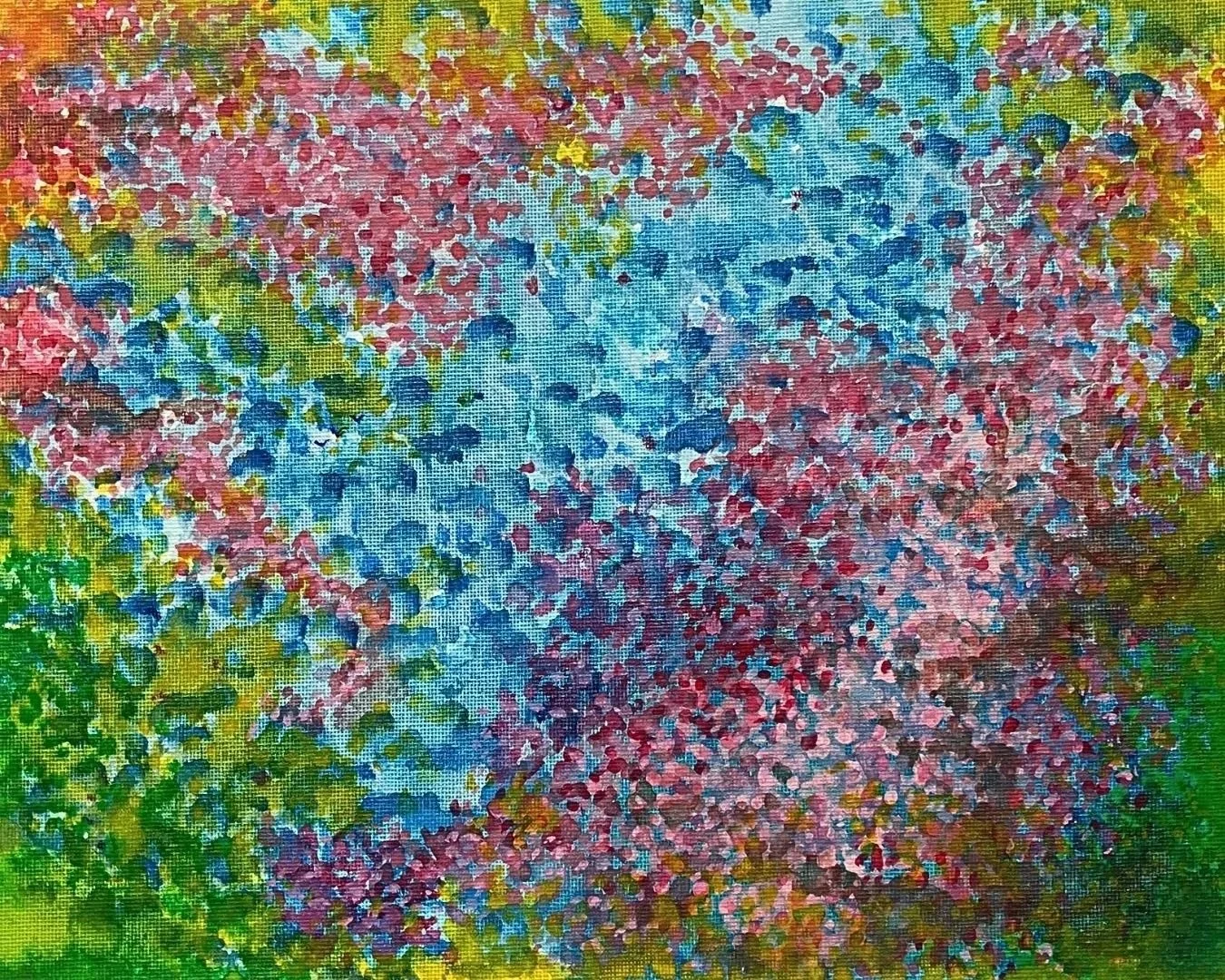
Memory Flutters, an original watercolour on linen by Sima Rahman-Huang, founder of Artists' Apothecary, was made from exactly this place. Painted during her own perimenopause, it does not try to resolve or pretty up the experience. Instead it holds it — the softness, the dissolution at the edges, the feeling of reaching for something that moves as you approach it. The watercolour medium itself enacts the theme: colour that bleeds and merges, form that refuses to be fixed.
It is, in the truest sense, art made from the inside of an experience rather than the outside of it. And that distinction matters.
Living Alongside the Transition
The women who tend to navigate perimenopause most steadily are not necessarily the ones who resist it most fiercely, but those who find ways to stay in relationship with themselves through it. That might look like therapy, or community, or movement, or creativity. It almost always involves some form of witness the sense that what is happening to you is real, is significant, and deserves to be met with care rather than dismissed.
Choosing what surrounds you matters more than we often admit. The objects in our homes, the images on our walls, the things we reach for when we need to feel held these are not trivial choices. The people we choose to surround our orbit alongside everything else. They are part of how we create an environment that supports rather than undermines our inner life.
An art print is a small thing. But something on your wall that says I see this, I painted this, this is real and it is also beautiful — that is not nothing. For many women, it is quietly everything.
Memory Flutters is available as a digital download from the Artists' Apothecary shop, ready to print at home or professionally on any material — fine art paper, canvas, linen, or fabric. View the listing here.